
Notes
What makes a floor plan AI-readable?
Give teams 400 unlabeled floor plans, three hours, and any AI tool. The goal: recover six housing attributes without touching the hidden labels.
The challenge
Give each team a folder of housing floor plans and three hours to turn them into structured data. For every plan, the system must estimate the number of bedrooms, bathrooms, and rooms; detect a sauna and a balcony; and identify the largest room type. I originally put this together as a hackathon I hoped to run at my previous lab.
The approach is open. Teams can train a small model, run OCR, ask a vision-language model, or mix the three. This is mainly a test of representation and problem framing, not raw coding speed.
Dataset
CubiCasa5K contains 5,000 floor plans from real Finnish homes, labeled by room and fixture.
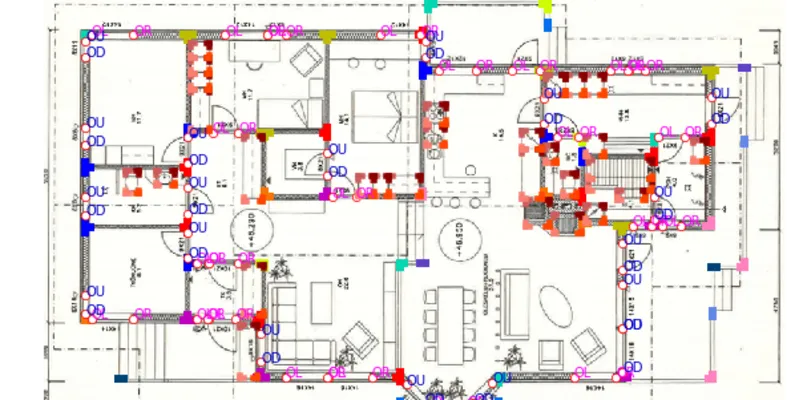
Teams receive:
- 4,600 practice plans with images and labels.
- 400 test plans with images only. The organizers keep the labels hidden.
What to predict
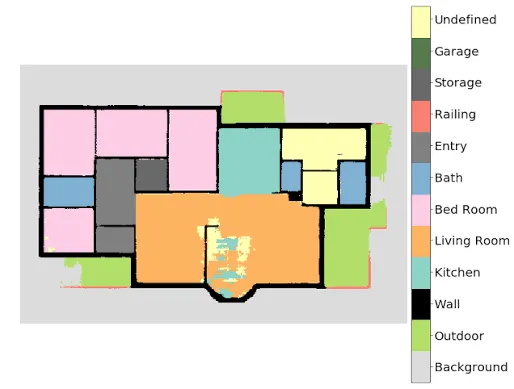
| Attribute | Weight |
|---|---|
| Bedroom count | 25 |
| Bathroom count | 20 |
| Total room count | 15 |
| Sauna | 15 |
| Balcony | 15 |
| Largest room type | 10 |
Scoring
Exact counts earn full credit; answers off by one earn half. Sauna and balcony use F1 scoring to discourage teams from guessing the same answer for every plan. Scores are averaged across the 400 test plans and combined using the weights above.
Each team submits a 400-row CSV. They get three attempts, and their best score counts.
Rules
- Do not view the hidden labels. CubiCasa5K is public, so downloading the original dataset would expose the test answers and lead to disqualification.
- Do not use a model pretrained on CubiCasa5K.
- Everything else is allowed, including AI coding tools and external AI services.
- Teams cannot share code or answers.
Why it matters
A floor plan makes sense to a person at a glance, but its data format is mostly tacit. Lines, symbols, text labels, and spatial relationships each carry a different part of the meaning.
What I really wanted from the hackathon was a quick comparison of representations: raw pixels, geometry, text annotations, or some mixture. My hunch was that text would get much further than people expected.